
Introduction
You have testimonials on your coaching website. Real ones. From real clients who got real results. So why aren’t they booking discovery calls?
Most coaches assume that having testimonials is enough. If people can see the five-star reviews, the trust is there. But there’s a significant gap between testimonials that exist on a page and coaching website testimonials that actually convert visitors into booked calls.
The problem isn’t that your clients aren’t saying great things. The problem is the kind of great things they’re saying — and where and how those things appear on your site. Here’s what’s actually happening and how to fix it.
Why “She Changed My Life” Doesn’t Book Calls
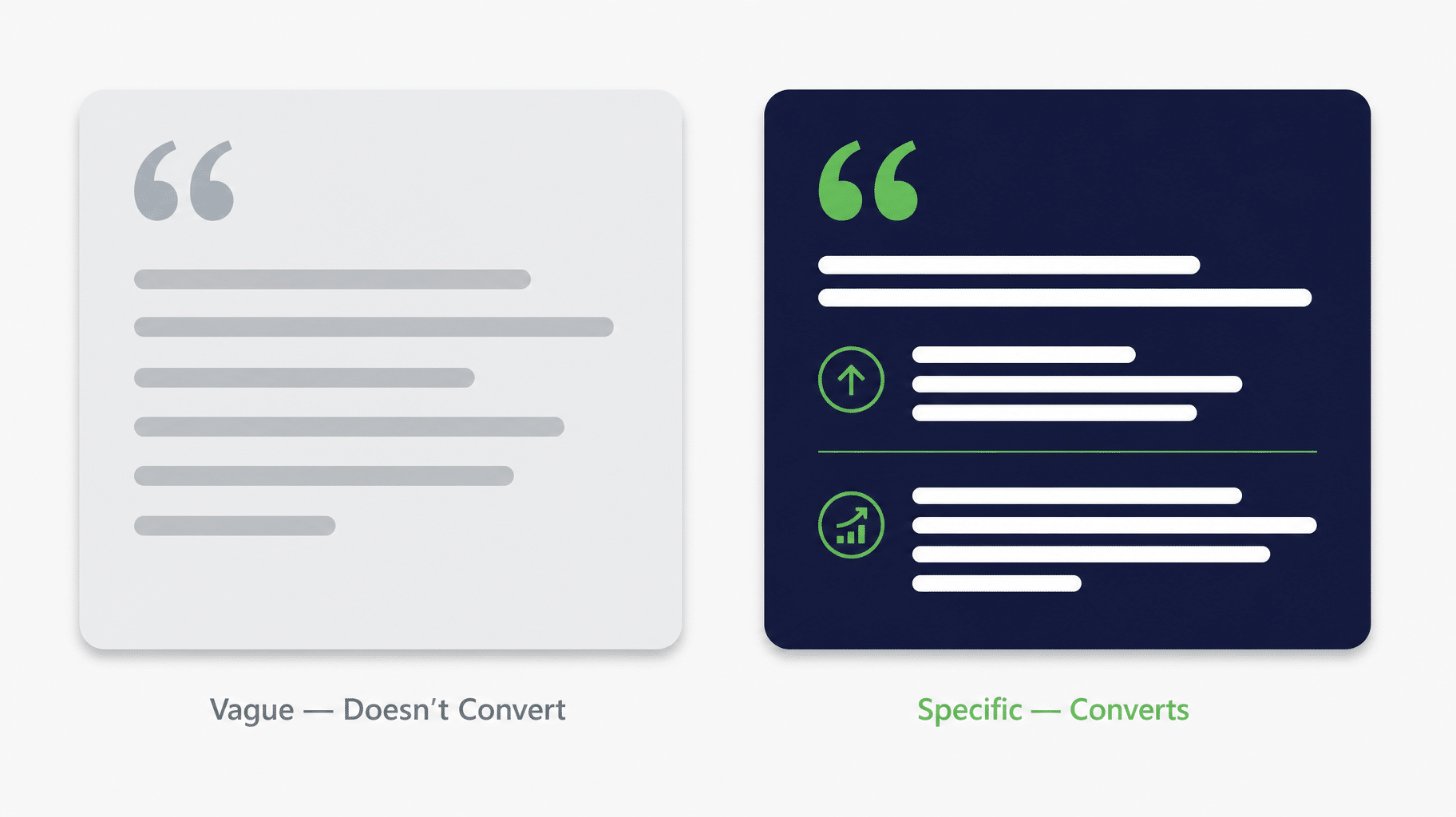
The most common testimonial on a coaching website sounds something like this: “Working with [Coach Name] was life-changing. She’s incredibly insightful and really helped me grow as a person. I highly recommend her.”
That testimonial feels good to read. It’s warm. It’s genuine. But it converts at almost zero — because it doesn’t tell your ideal client anything specific about what changed, how it changed, or why it would matter to them.
When a visitor reads a vague testimonial, they can’t see themselves in it. They can’t visualize the outcome. They can’t connect the praise to their own situation. And without that connection, even glowing endorsements slide off the page without leaving an impression.
Compare that to: “Before working with Shawn, my website was getting 200 visitors a month and booking zero calls. Three months later, I’m booking 14 discovery calls a month and hitting $40K. The difference was one system.” That testimonial does three things: it names a before state, describes a specific result, and credits a clear mechanism. A coach reading that knows exactly what changed and whether they want the same thing.
Specific proof converts. Vague praise doesn’t.
The 3-Part Testimonial Formula That Actually Works
Not all testimonials are created equal. The ones that build trust and book calls follow a consistent structure — whether your clients wrote them that way or not.
Part 1: The Before State What was the client’s situation before they worked with you? What problem were they stuck in? What had they already tried? The before state creates instant recognition for your ideal client. When they see themselves in someone else’s struggle, they pay attention.
Part 2: The Specific Result What changed? Not in vague terms — in measurable, concrete terms. Revenue. Lead count. Confidence level. Time freed. Calls booked. The more specific the result, the more believable and compelling it becomes. “I doubled my income” is good. “I went from $4,500 to $9,200 a month in 60 days” is better.
Part 3: The Credit What specifically made the difference? Was it a framework? A system? A single conversation? A mindset shift? When your client credits something specific to your work, it tells future clients exactly what to expect — and what they’re buying.
Most of your existing testimonials already contain these three elements. They’re just buried in vague language. The fix is often as simple as reaching back out to past clients and asking three focused questions.
Not sure if your current social proof is building trust or blending in? Book a free 15-minute diagnostic and we’ll look at your credibility section together. 👉 shawnbrooks.com/?fluent-booking=calendar&host=shawn&event=15min-1
How to Ask for Better Testimonials
The easiest way to get stronger testimonials is to ask better questions. Most coaches send a generic “Would you leave me a review?” message and get a generic response back. Instead, give your clients a framework that pulls out the specifics.
Ask these three questions:
1. “What was going on before we worked together — what were you struggling with?” This surfaces the before state in their own words.
2. “What specifically changed after we worked together — what results did you see?” This pulls out the concrete outcome. Follow up with: “Can you give me a number if possible?”
3. “What would you tell someone who’s considering working with me?” This closes with a recommendation that speaks directly to your future clients.
When clients answer these three questions, you get a testimonial that tells a complete story. You can also edit their responses into the 3-part format with their permission — keeping their words, just tightening the structure.
MrsMD used this approach after we rebuilt her credibility section. The result: 3,200+ leads in six months. Same offer, same coach — but now the proof on her site told a story that her ideal clients could see themselves in.
Where Your Testimonials Live Matters As Much As What They Say
Even a perfect testimonial loses its power if it’s buried on a dedicated “testimonials” page that no one visits. Most coaching websites make this mistake — they collect all their social proof in one place and assume visitors will go looking for it.
They won’t.
Your strongest testimonials belong on your homepage, above the fold if possible, and positioned directly after you’ve described the problem you solve. That sequence — problem → proof that you solved it — is what converts. The visitor reads that you understand their situation, then immediately sees evidence that you’ve fixed it for someone else. That combination is what moves people from “interesting” to “I need to book a call.”
Place one strong, specific testimonial in your hero section or just below it. Pull another into your services section — right next to the offer it most directly supports. Use a third near your call-to-action. Scattered throughout the page, your social proof reinforces every section rather than living in isolation on a page no one visits.
👉 Grab the free Website Conversion Checklist — it walks you through the exact placement strategy for social proof on each section of your homepage.
The Credibility Section Most Coaches Are Missing
Beyond testimonials, there’s a layer of social proof that most coaching websites skip entirely: outcome-based proof points.
Instead of (or in addition to) traditional testimonials, consider featuring:
- Specific numbers. “3,000+ coaches and consultants served.” “108 leads generated in 2 weeks.” These numbers don’t require a client quote — they stand on their own.
- Before/after case studies. One paragraph: where the client started, what you did together, where they ended up. Specific enough to feel real, brief enough to be read.
- Named client results. Not generic wins — attributed outcomes. “Marcus went from 200 monthly visitors to $40K/month.” A name and a number together are more credible than either one alone.
Together, these elements build what your ideal client actually needs before they’ll book: certainty that you’ve done this before and gotten real results. Not general confidence in coaching — specific confidence in you.
The Fix Starts With One Testimonial
You don’t need to overhaul your entire credibility section this week. Start with one testimonial.
Find the strongest result story you have — the client whose before and after is the most dramatic and most specific. Reach out and ask the three questions. Shape their response into the 3-part formula. Then move it to a prominent place on your homepage, as close to above the fold as your layout allows.
That one change — one specific, well-placed testimonial — will do more for your conversion rate than a full page of vague praise ever could. Then build from there. Over time, your homepage becomes a library of proof that makes the decision to book a call feel obvious.
Book a free 15-minute website diagnostic and find out whether your social proof is building trust or blending into the background. 👉 shawnbrooks.com/?fluent-booking=calendar&host=shawn&event=15min-1
For daily coaching website tips, follow on Instagram → instagram.com/shawnbrooks