
Introduction
Your homepage headline is the most important sentence on your entire coaching website. It’s the first thing a visitor reads. It sets the tone for everything that follows. And if it doesn’t land — if it’s vague, generic, or all about you — most visitors will leave before they read another word.
A homepage headline that books discovery calls does one specific thing: it makes your ideal client feel immediately understood. Not impressed by your credentials. Not curious about your certifications. Understood. That’s the trigger that keeps someone on your page and moves them toward booking a call.
Here’s how to build one.
Why Most Coaching Website Headlines Don’t Convert
Most coaching website headlines fall into one of two traps.
The first is the name-and-title headline: “Hi, I’m [Name], a certified executive coach.” This tells a visitor who you are but says nothing about whether you can help them. It leads with the coach, not the client.
The second is the vague transformation headline: “Unlock your potential and live your best life.” This sounds inspiring, but it doesn’t mean anything specific. It could apply to a yoga instructor, a nutritionist, a therapist, or a hundred other coaches. When everything could be for everyone, nothing feels like it’s for the right person.
Both of these headline types share the same problem: they don’t speak directly to what your ideal client is experiencing right now, today, at the moment they land on your page. And when visitors don’t feel immediately seen, they move on.
The 3-Part Framework for a Headline That Converts
A strong coaching homepage headline has three components working together. You don’t always need all three in a single line — sometimes you split them across a headline and a subheadline — but all three ideas need to be visible above the fold.
1. Who you help (specifically) Not “entrepreneurs” or “professionals.” The more specific you get, the more your ideal client feels like you’re talking directly to them. “Female executives in their 40s navigating career transitions” is more powerful than “professionals looking for change” — even though it addresses a smaller audience on paper.
2. The problem or frustration they’re living with right now Lead with where they are, not where they’re going. Your visitor is in pain. They’re frustrated. They’re stuck. Name that. When someone reads your headline and thinks “that’s exactly what I’m going through” — you’ve earned their attention.
3. The specific outcome they want What does life look like after working with you? Not in abstract terms. In real, tangible terms. More booked calls. A clearer career direction. A business that runs without 60-hour weeks. Specificity builds trust. Vague promises feel like noise.
Want to see how your current headline stacks up? Book a free 15-minute diagnostic and get specific feedback on your homepage copy. 👉 shawnbrooks.com/?fluent-booking=calendar&host=shawn&event=15min-1
Real Examples: Before and After
Let’s look at what this framework looks like in practice.
Before: “Helping professionals reach their full potential.”
After: “I help established coaches turn their website into a discovery call machine — without rebuilding from scratch.”
The “before” version could be anyone. The “after” version speaks to a specific person with a specific problem and a specific desired outcome. A coach reading the “after” version immediately knows whether it’s for them.
Before: “Certified life coach helping you find balance and purpose.”
After: “Helping burned-out corporate leaders build a consulting business they can run in 20 hours a week.”
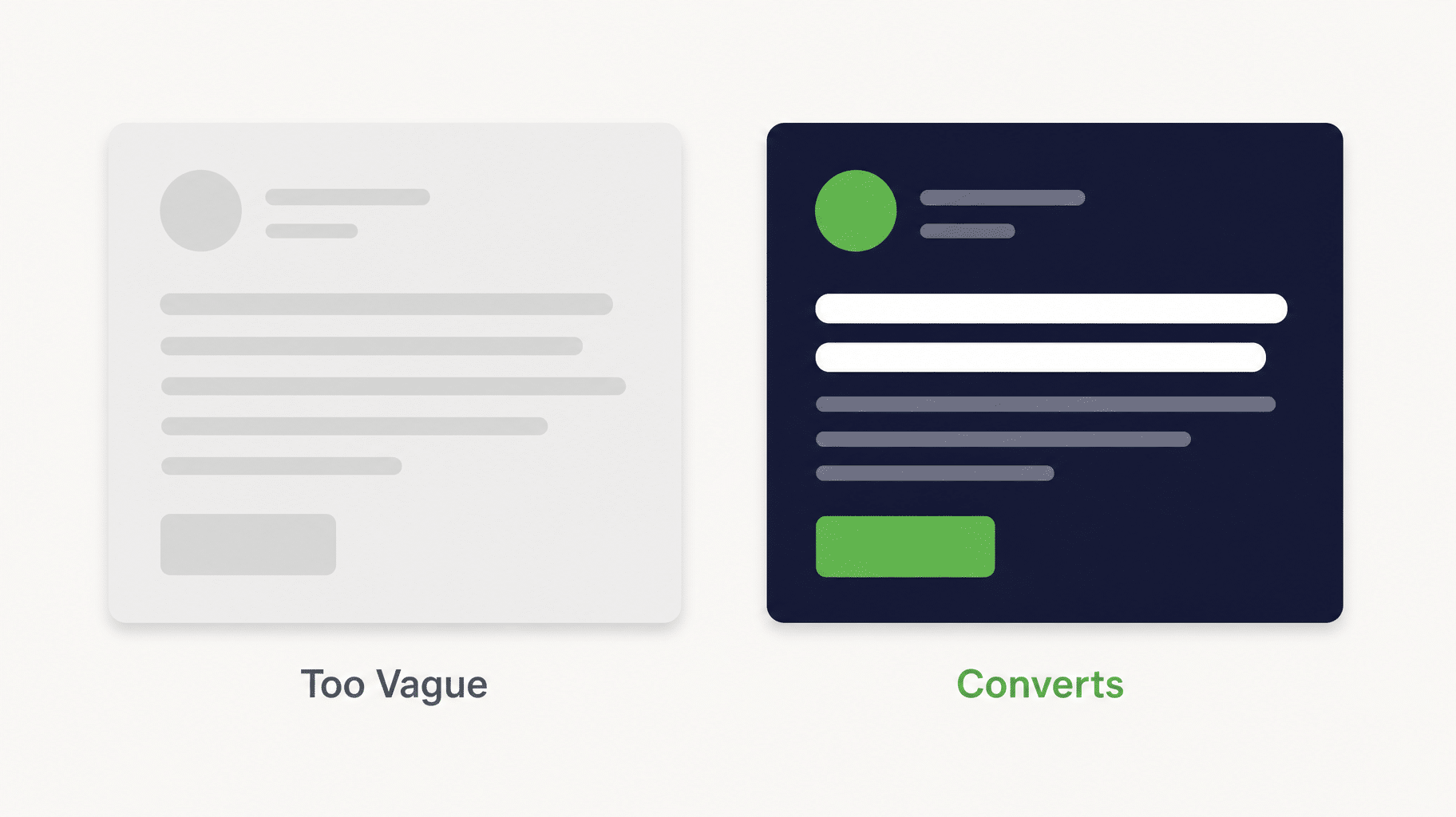
Same coach, same transformation. But the second version is clear, targeted, and specific. It filters out the wrong people and pulls in the right ones. That filtering effect matters. A broad headline attracts the wrong visitors, who bounce quickly and never convert. A specific headline attracts fewer people — but they’re your people. They read. They scroll. They book.
The “So What?” Test
Once you’ve written a headline, run it through the “So What?” test. Read your headline out loud and ask: so what?
If the answer is “I don’t know” or “it could mean a lot of things,” your headline needs more specificity. Keep asking “so what?” until you’ve drilled down to the real, concrete outcome your client actually wants.
“I help coaches build confidence.” So what? “So they can show up more powerfully in their business.” So what? “So they can charge higher rates and stop undervaluing their work.” Now you’re getting somewhere. That last version — with the right client language — is the foundation of a headline that converts.
You can also check your headline against the free Website Conversion Checklist, which covers your hero section, headline, and all seven homepage sections that determine whether visitors book or bounce.
👉 Grab the free Website Conversion Checklist
One Sentence Can Change Everything
I worked with a coach named Marcus who had a clean, professional website and roughly 200 visitors a month. He was booking almost no discovery calls. His headline led with his name and credentials — nothing about his client or their problem.
After we rewrote his headline using this exact framework — specific audience, real frustration, clear outcome — his discovery call bookings went from near zero to 14 in a single month. Same traffic. Same offer. Different headline.
He was at $40K per month within 90 days. One sentence changed the trajectory of his business. That’s how much your homepage headline that books discovery calls actually matters.
Where to Start Today
Open your homepage right now. Read your headline. Ask yourself: if a stranger landed here with no context, would they know in five seconds exactly who you help, what problem you solve, and what result they’d get?
If the answer is no — or even “maybe” — your headline is costing you clients every single day.
Rewrite it using the three-part framework: specific audience, real frustration, tangible outcome. Test a few versions. Get feedback. The right headline doesn’t just describe what you do — it makes the right person feel like they finally found exactly what they’ve been looking for.
Book a free 15-minute website diagnostic and get direct feedback on your homepage headline and positioning. 👉 shawnbrooks.com/?fluent-booking=calendar&host=shawn&event=15min-1
For daily coaching website tips, follow on Instagram → instagram.com/shawnbrooks